Bethlehem

66 Images & Collections results for Bethlehem

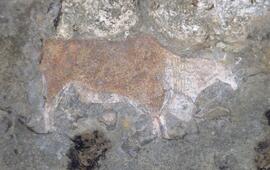
IZI 02 70HC
IZI IZI-IZI-02-70HC.jpg · Item · 16/01/1942
Part of Iziko Museum
6006 Schaapplaats I 1785
JDC 02 265
JDC JDC-JDC-02-265.jpg · Item · 9/1997
Part of Deacon, Janette
Le Fort. Eland.

The eland was the first animal that the San trickster deity, /Kaggen created and it remained his favourite.
The eland is the largest of southern African antelope and is much desired for its meat and fat. The San say that all other animals are like servants to the eland.

The importance of this animal is shown in the great variety of postures and perspectives. It is depicted running with tail outstretched, with uplifted head smelling the wind, and upside down, presumably dead. The eland is also depicted from the front or from the back, and even from above.

The eland appears in four important San rituals it is the most carefully depicted antelope in both rock paintings and engravings: Trance dance, boy's first kill, girl's puberty and marriage. It is believed that eland fat contains a lot of potency and in a trance dance shamans aspire to possess eland potency.
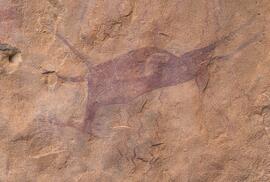
Letsoana Stad I 347
NASMUS RSA LAR1 4
ZA NASMUS NASMUS-NASMUS-RSA-LAR1-4.jpg · Item · 01/1994
Part of National Museum
Zigzags.Rain animals.

Rain-making was one of the San shamans’ most important tasks. The southern San thought of the rain as an animal. This animal was an amorphous quadruped that generally resembled a hippopotamus, but it could also look like an ox or an antelope. A male rain-animal, or rain-bull, was associated with the frightening thunderstorm that bellowed, stirred up the dust, and sometimes killed people with its lightning. The female rain animal was associated with soft, soaking rains.
La Rochelle I 1563
NASMUS RSA NOD1 8
ZA NASMUS NASMUS-NASMUS-RSA-NOD1-8.jpg · Item · 01/1997
Part of National Museum
Zigzags, antelopes and bleeding from the nose. Node I 77
NASMUS RSA SAI1 6
ZA NASMUS NASMUS-NASMUS-RSA-SAI1-6.jpg · Item · 06/03/1997
Part of National Museum
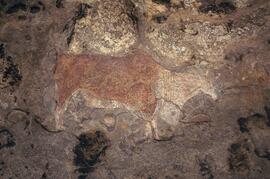
Eland.

The eland was the first animal that the San trickster deity, /Kaggen created and it remained his favourite.
The eland is the largest of southern African antelope and is much desired for its meat and fat. The San say that all other animals are like servants to the eland.

The importance of this animal is shown in the great variety of postures and perspectives. It is depicted running with tail outstretched, with uplifted head smelling the wind, and upside down, presumably dead. The eland is also depicted from the front or from the back, and even from above.

The eland appears in four important San rituals it is the most carefully depicted antelope in both rock paintings and engravings: Trance dance, boy's first kill, girl's puberty and marriage. It is believed that eland fat contains a lot of potency and in a trance dance shamans aspire to possess eland potency.
Letsoana Stad I 347
NASMUS RSA SKA1 3R
ZA NASMUS NASMUS-NASMUS-RSA-SKA1-3R.jpg · Item · 07/03/2000
Part of National Museum
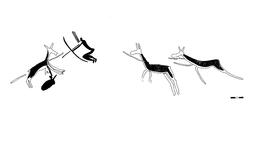
Bows and arrows. Rhebuck (reedbuck).

Rhebuck is one of the antelope that are most frequently depicted, after the eland. The rhebuck is comparable to the eland because it is often painted in shaded polychrome. Both eland and rhebuck are depicted in two colours, mainly red and white, even though they are more grey than red. Depictions of men with rhebuck heads are shamans. It is known that shamans with rhebuck heads controlled eland and harnessed their power to enter trance and to perform their various tasks, including rain-making.
Schaapplaats I 1785
RARI LEE RSA ALA4 16
LEE LEE-RARI-LEE-RSA-ALA4-16.jpg · Item · 19/07/2000
Part of Lee, Neil
Quivers.

Quivers are usually made of bark and are used to store arrows. The quiver, bow and other pieces of equipment were carried on a hunting bag, which is wider at one end than the other and which has a thong running its length so that it can be slung over a shoulder.
Wartrail I
RARI LEE RSA ALA4 20
LEE LEE-RARI-LEE-RSA-ALA4-20.jpg · Item
Part of Lee, Neil
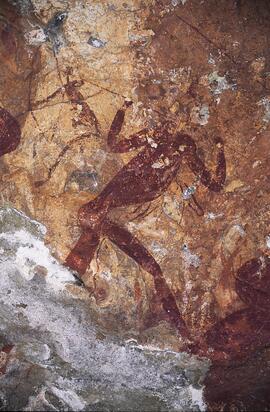
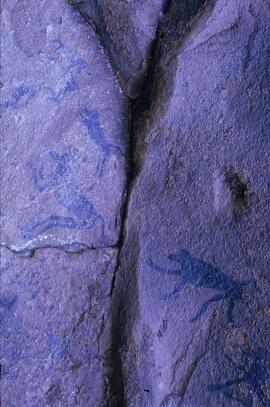
Baboons.

Baboons are painted and engraved more frequently than jackals, and they also feature more frequently in Bushman myth and folklore. The /Xam believed that, like the lion, the baboon had similar powers to those of shamans. It was supposed to draw these powers from a small stick of a plant, which it kept in its left cheek. Some depictions of baboons show a whole troop with males, females and babies. There are also therianthropic baboons which express the closeness of baboons to people and, more important, the association between baboons and shamans.
Lee, Neil
RARI LEE RSA ALA4 31
LEE LEE-RARI-LEE-RSA-ALA4-31.jpg · Item
Part of Lee, Neil
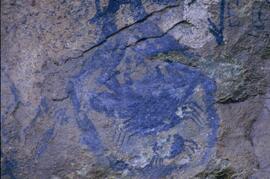
Crabs.

From time to time one finds paintings that one may consider to be unique. This is the case of depictions of crabs, which are rare in rock art. It is possible that these depictions may have some reference to the ‘underwater’ metaphor, like eels and fish.
Lee, Neil
RARI LEE RSA ALA4 32
LEE LEE-RARI-LEE-RSA-ALA4-32.jpg · Item
Part of Lee, Neil
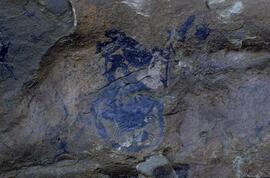
Crabs.

From time to time one finds paintings that one may consider to be unique. This is the case of depictions of crabs, which are rare in rock art. It is possible that these depictions may have some reference to the ‘underwater’ metaphor, like eels and fish.
Lee, Neil
RARI LEE RSA ALA4 8
LEE LEE-RARI-LEE-RSA-ALA4-8.jpg · Item · 19/07/2000
Part of Lee, Neil
Quivers.

Quivers are usually made of bark and are used to store arrows. The quiver, bow and other pieces of equipment were carried on a hunting bag, which is wider at one end than the other and which has a thong running its length so that it can be slung over a shoulder.
Wartrail I