Cloebert I

Elements area

Taxonomy

Code

Scope note(s)

    Source note(s)

      Display note(s)

        Hierarchical terms

        Cloebert I

        Cloebert I

          Equivalent terms

          Cloebert I

            Associated terms

            Cloebert I

              18 Images & Collections results for Cloebert I

              18 results directly related Exclude narrower terms
              RARI LEE RSA CLO1 14
              LEE LEE-RARI-LEE-RSA-CLO1-14.jpg · Item
              Part of Lee, Neil
              Eland.

              The eland was the first animal that the San trickster deity, /Kaggen created and it remained his favourite.
              The eland is the largest of southern African antelope and is much desired for its meat and fat. The San say that all other animals are like servants to the eland.

              The importance of this animal is shown in the great variety of postures and perspectives. It is depicted running with tail outstretched, with uplifted head smelling the wind, and upside down, presumably dead. The eland is also depicted from the front or from the back, and even from above.

              The eland appears in four important San rituals it is the most carefully depicted antelope in both rock paintings and engravings: Trance dance, boy's first kill, girl's puberty and marriage. It is believed that eland fat contains a lot of potency and in a trance dance shamans aspire to possess eland potency.
              Cloebert I
              RARI LEE RSA CLO1 17
              LEE LEE-RARI-LEE-RSA-CLO1-17.jpg · Item
              Part of Lee, Neil
              Eland.

              The eland was the first animal that the San trickster deity, /Kaggen created and it remained his favourite.
              The eland is the largest of southern African antelope and is much desired for its meat and fat. The San say that all other animals are like servants to the eland.

              The importance of this animal is shown in the great variety of postures and perspectives. It is depicted running with tail outstretched, with uplifted head smelling the wind, and upside down, presumably dead. The eland is also depicted from the front or from the back, and even from above.

              The eland appears in four important San rituals it is the most carefully depicted antelope in both rock paintings and engravings: Trance dance, boy's first kill, girl's puberty and marriage. It is believed that eland fat contains a lot of potency and in a trance dance shamans aspire to possess eland potency.
              Cloebert I
              RARI LEE RSA CLO1 24
              LEE LEE-RARI-LEE-RSA-CLO1-24.jpg · Item
              Part of Lee, Neil
              Flywhisks. Red hartebeest.

              Depictions of flywhisks in rock art are quite common. They are important accessories for the trance dance in which they are used to keep arrows of sickness at bay.Paintings of them are a good indication of trance.
              Cloebert I
              RARI LEE RSA CLO1 27
              LEE LEE-RARI-LEE-RSA-CLO1-27.jpg · Item
              Part of Lee, Neil
              Eland.

              The eland was the first animal that the San trickster deity, /Kaggen created and it remained his favourite.
              The eland is the largest of southern African antelope and is much desired for its meat and fat. The San say that all other animals are like servants to the eland.

              The importance of this animal is shown in the great variety of postures and perspectives. It is depicted running with tail outstretched, with uplifted head smelling the wind, and upside down, presumably dead. The eland is also depicted from the front or from the back, and even from above.

              The eland appears in four important San rituals it is the most carefully depicted antelope in both rock paintings and engravings: Trance dance, boy's first kill, girl's puberty and marriage. It is believed that eland fat contains a lot of potency and in a trance dance shamans aspire to possess eland potency.
              Cloebert I
              RARI LEE RSA CLO1 36
              LEE LEE-RARI-LEE-RSA-CLO1-36.jpg · Item
              Part of Lee, Neil
              Eland.

              The eland was the first animal that the San trickster deity, /Kaggen created and it remained his favourite.
              The eland is the largest of southern African antelope and is much desired for its meat and fat. The San say that all other animals are like servants to the eland.

              The importance of this animal is shown in the great variety of postures and perspectives. It is depicted running with tail outstretched, with uplifted head smelling the wind, and upside down, presumably dead. The eland is also depicted from the front or from the back, and even from above.

              The eland appears in four important San rituals it is the most carefully depicted antelope in both rock paintings and engravings: Trance dance, boy's first kill, girl's puberty and marriage. It is believed that eland fat contains a lot of potency and in a trance dance shamans aspire to possess eland potency.
              Cloebert I
              RARI LEE RSA CLO1 40
              LEE LEE-RARI-LEE-RSA-CLO1-40.jpg · Item
              Part of Lee, Neil
              Fish, eels and turtles, these represent the 'underwater'
              experience of the Shamans in the altered state of consciousness. Flywhisks.
              Published in Images of Power page 88 and 89.

              Depictions of flywhisks in rock art are quite common. They are important accessories for the trance dance in which they are used to keep arrows of sickness at bay.Paintings of them are a good indication of trance.
              Cloebert I
              RARI LEE RSA CLO1 48
              LEE LEE-RARI-LEE-RSA-CLO1-48.jpg · Item
              Part of Lee, Neil
              Eland.

              The eland was the first animal that the San trickster deity, /Kaggen created and it remained his favourite.
              The eland is the largest of southern African antelope and is much desired for its meat and fat. The San say that all other animals are like servants to the eland.

              The importance of this animal is shown in the great variety of postures and perspectives. It is depicted running with tail outstretched, with uplifted head smelling the wind, and upside down, presumably dead. The eland is also depicted from the front or from the back, and even from above.

              The eland appears in four important San rituals it is the most carefully depicted antelope in both rock paintings and engravings: Trance dance, boy's first kill, girl's puberty and marriage. It is believed that eland fat contains a lot of potency and in a trance dance shamans aspire to possess eland potency.
              Cloebert I
              RARI LEE RSA CLO1 51
              LEE LEE-RARI-LEE-RSA-CLO1-51.jpg · Item
              Part of Lee, Neil
              Eland.

              The eland was the first animal that the San trickster deity, /Kaggen created and it remained his favourite.
              The eland is the largest of southern African antelope and is much desired for its meat and fat. The San say that all other animals are like servants to the eland.

              The importance of this animal is shown in the great variety of postures and perspectives. It is depicted running with tail outstretched, with uplifted head smelling the wind, and upside down, presumably dead. The eland is also depicted from the front or from the back, and even from above.

              The eland appears in four important San rituals it is the most carefully depicted antelope in both rock paintings and engravings: Trance dance, boy's first kill, girl's puberty and marriage. It is believed that eland fat contains a lot of potency and in a trance dance shamans aspire to possess eland potency.
              Cloebert I
              RARI LEE RSA CLO1 54
              LEE LEE-RARI-LEE-RSA-CLO1-54.jpg · Item
              Part of Lee, Neil
              Eland.

              The eland was the first animal that the San trickster deity, /Kaggen created and it remained his favourite.
              The eland is the largest of southern African antelope and is much desired for its meat and fat. The San say that all other animals are like servants to the eland.

              The importance of this animal is shown in the great variety of postures and perspectives. It is depicted running with tail outstretched, with uplifted head smelling the wind, and upside down, presumably dead. The eland is also depicted from the front or from the back, and even from above.

              The eland appears in four important San rituals it is the most carefully depicted antelope in both rock paintings and engravings: Trance dance, boy's first kill, girl's puberty and marriage. It is believed that eland fat contains a lot of potency and in a trance dance shamans aspire to possess eland potency.
              Cloebert I
              RARI RSA CLO1 2R
              RARI RARI-RARI-RSA-CLO1-2R.jpg · Item · 01/06/1988
              Part of RARI
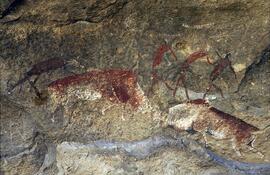
              Mormyrid fish, eels and turtles, these represent the 'underwater' experience of the Shamans in the altered state of consciousness. Flywhisks.Therianthropes.

              Published in 'Images of Power' page 88 and 89, in 'The Mind In the Cave' page 148, in 'Images of Mystery' page 52 and in 'A Cosmos in Stone' by Lewis-Williams, J.D., page 100 and 156.
              Dowson, Thomas
              RSA CLO1 17
              RARI RARI-RSA-CLO1-17.jpg · Item · 17/12/1996
              Part of RARI
              Eland.

              The eland was the first animal that the San trickster deity, /Kaggen created and it remained his favourite.
              The eland is the largest of southern African antelope and is much desired for its meat and fat. The San say that all other animals are like servants to the eland.

              The importance of this animal is shown in the great variety of postures and perspectives. It is depicted running with tail outstretched, with uplifted head smelling the wind, and upside down, presumably dead. The eland is also depicted from the front or from the back, and even from above.

              The eland appears in four important San rituals it is the most carefully depicted antelope in both rock paintings and engravings: Trance dance, boy's first kill, girl's puberty and marriage. It is believed that eland fat contains a lot of potency and in a trance dance shamans aspire to possess eland potency.
              Hollmann, Jeremy
              RSA CLO1 19
              RARI RARI-RSA-CLO1-19.jpg · Item · 17/12/1996
              Part of RARI
              Eland.

              The eland was the first animal that the San trickster deity, /Kaggen created and it remained his favourite.
              The eland is the largest of southern African antelope and is much desired for its meat and fat. The San say that all other animals are like servants to the eland.

              The importance of this animal is shown in the great variety of postures and perspectives. It is depicted running with tail outstretched, with uplifted head smelling the wind, and upside down, presumably dead. The eland is also depicted from the front or from the back, and even from above.

              The eland appears in four important San rituals it is the most carefully depicted antelope in both rock paintings and engravings: Trance dance, boy's first kill, girl's puberty and marriage. It is believed that eland fat contains a lot of potency and in a trance dance shamans aspire to possess eland potency.
              Hollmann, Jeremy