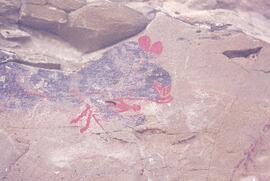
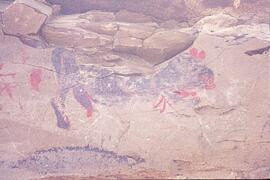
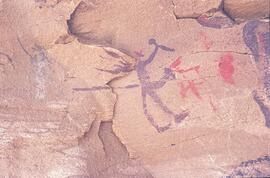
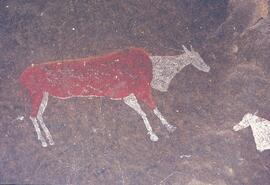
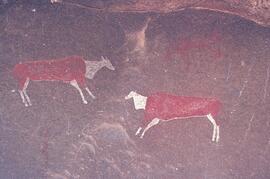
Rain-making was one of the San shamans’ most important tasks. The southern San thought of the rain as an animal. This animal was an amorphous quadruped that generally resembled a hippopotamus, but it could also look like an ox or an antelope. A male rain-animal, or rain-bull, was associated with the frightening thunderstorm that bellowed, stirred up the dust, and sometimes killed people with its lightning. The female rain animal was associated with soft, soaking rains.
Lee, Neil
Rain-making was one of the San shamans’ most important tasks. The southern San thought of the rain as an animal. This animal was an amorphous quadruped that generally resembled a hippopotamus, but it could also look like an ox or an antelope. A male rain-animal, or rain-bull, was associated with the frightening thunderstorm that bellowed, stirred up the dust, and sometimes killed people with its lightning. The female rain animal was associated with soft, soaking rains.
Lee, Neil
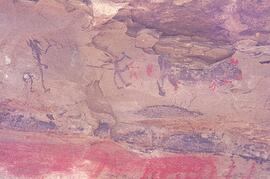
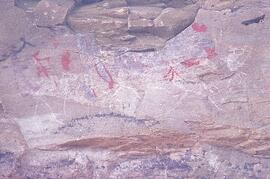
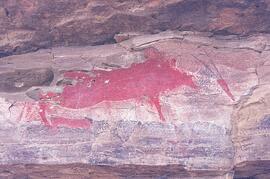
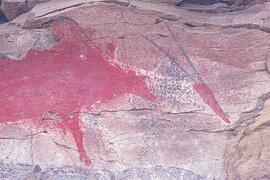
The eland was the first animal that the San trickster deity, /Kaggen created and it remained his favourite. The eland is the largest of southern African antelope and is much desired for its meat and fat. The San say that all other animals are like servants to the eland.
The importance of this animal is shown in the great variety of postures and perspectives. It is depicted running with tail outstretched, with uplifted head smelling the wind, and upside down, presumably dead. The eland is also depicted from the front or from the back, and even from above.
The eland appears in four important San rituals it is the most carefully depicted antelope in both rock paintings and engravings: Trance dance, boy's first kill, girl's puberty and marriage. It is believed that eland fat contains a lot of potency and in a trance dance shamans aspire to possess eland potency.
Lee, Neil
The eland was the first animal that the San trickster deity, /Kaggen created and it remained his favourite. The eland is the largest of southern African antelope and is much desired for its meat and fat. The San say that all other animals are like servants to the eland.
The importance of this animal is shown in the great variety of postures and perspectives. It is depicted running with tail outstretched, with uplifted head smelling the wind, and upside down, presumably dead. The eland is also depicted from the front or from the back, and even from above.
The eland appears in four important San rituals it is the most carefully depicted antelope in both rock paintings and engravings: Trance dance, boy's first kill, girl's puberty and marriage. It is believed that eland fat contains a lot of potency and in a trance dance shamans aspire to possess eland potency.
Lee, Neil
The eland was the first animal that the San trickster deity, /Kaggen created and it remained his favourite. The eland is the largest of southern African antelope and is much desired for its meat and fat. The San say that all other animals are like servants to the eland.
The importance of this animal is shown in the great variety of postures and perspectives. It is depicted running with tail outstretched, with uplifted head smelling the wind, and upside down, presumably dead. The eland is also depicted from the front or from the back, and even from above.
The eland appears in four important San rituals it is the most carefully depicted antelope in both rock paintings and engravings: Trance dance, boy's first kill, girl's puberty and marriage. It is believed that eland fat contains a lot of potency and in a trance dance shamans aspire to possess eland potency.
Lee, Neil
The eland was the first animal that the San trickster deity, /Kaggen created and it remained his favourite. The eland is the largest of southern African antelope and is much desired for its meat and fat. The San say that all other animals are like servants to the eland.
The importance of this animal is shown in the great variety of postures and perspectives. It is depicted running with tail outstretched, with uplifted head smelling the wind, and upside down, presumably dead. The eland is also depicted from the front or from the back, and even from above.
The eland appears in four important San rituals it is the most carefully depicted antelope in both rock paintings and engravings: Trance dance, boy's first kill, girl's puberty and marriage. It is believed that eland fat contains a lot of potency and in a trance dance shamans aspire to possess eland potency.
Lee, Neil