Labyrinth I 56

Elements area

Taxonomy

Code

Scope note(s)

    Source note(s)

      Display note(s)

        Hierarchical terms

        Labyrinth I 56

        Labyrinth I 56

          Equivalent terms

          Labyrinth I 56

            Associated terms

            Labyrinth I 56

              16 Images & Collections results for Labyrinth I 56

              16 results directly related Exclude narrower terms
              NASMUS RSA LAB1 31
              ZA NASMUS NASMUS-NASMUS-RSA-LAB1-31.jpg · Item · 19/10/2001
              Part of National Museum
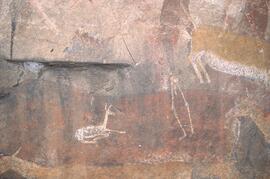
              Running figures, quivers, bows, SDFs Labyrinth I 56
              NASMUS RSA LAB1 53
              ZA NASMUS NASMUS-NASMUS-RSA-LAB1-53.jpg · Item · 19/10/2001
              Part of National Museum
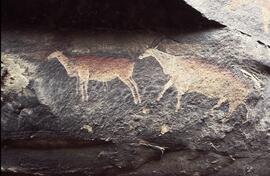
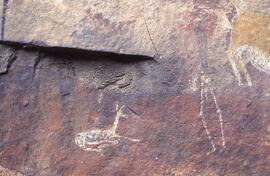
              Bows. Rhebuck (reedbuck)

              Rhebuck is one of the antelope that are most frequently depicted, after the eland. The rhebuck is comparable to the eland because it is often painted in shaded polychrome. Both eland and rhebuck are depicted in two colours, mainly red and white, even though they are more grey than red. Depictions of men with rhebuck heads are shamans. It is known that shamans with rhebuck heads controlled eland and harnessed their power to enter trance and to perform their various tasks, including rain-making.
              Labyrinth I 56
              RARI RSA LAB1 21
              RARI RARI-RSA-LAB1-21.jpg · Item · 16/12/1998
              Part of RARI
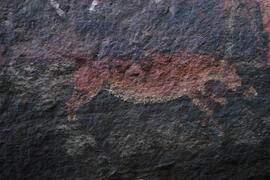
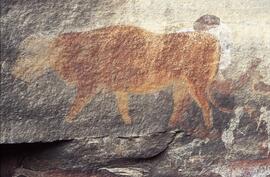
              Rain animals, felines

              Rain-making was one of the San shamans’ most important tasks. The southern San thought of the rain as an animal. This animal was an amorphous quadruped that generally resembled a hippopotamus, but it could also look like an ox or an antelope. A male rain-animal, or rain-bull, was associated with the frightening thunderstorm that bellowed, stirred up the dust, and sometimes killed people with its lightning. The female rain animal was associated with soft, soaking rains.
              Labyrinth I 56
              RARI RSA LAB1 21D
              RARI RARI-RARI-RSA-LAB1-21D.jpg · Item · 17/12/2004
              Part of RARI
              Felines. Hoerle, Stephane
              RARI RSA LAB1 53D
              RARI RARI-RARI-RSA-LAB1-53D.jpg · Item · 10/12/2005
              Part of RARI
              Type 2B, fingerpainted, human figures, bows Labyrinth I 56
              RSA LAB1 103
              RARI RARI-RSA-LAB1-103.jpg · Item · 24/12/1995
              Part of RARI
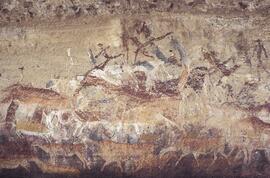
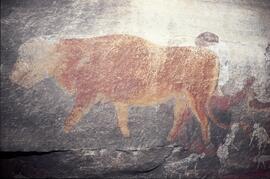
              Eland

              The eland was the first animal that the San trickster deity, /Kaggen created and it remained his favourite.
              The eland is the largest of southern African antelope and is much desired for its meat and fat. The San say that all other animals are like servants to the eland.

              The importance of this animal is shown in the great variety of postures and perspectives. It is depicted running with tail outstretched, with uplifted head smelling the wind, and upside down, presumably dead. The eland is also depicted from the front or from the back, and even from above.

              The eland appears in four important San rituals it is the most carefully depicted antelope in both rock paintings and engravings: Trance dance, boy's first kill, girl's puberty and marriage. It is believed that eland fat contains a lot of potency and in a trance dance shamans aspire to possess eland potency.
              Blundell, Geoffrey
              RSA LAB1 106
              RARI RARI-RSA-LAB1-106.jpg · Item · 24/12/1995
              Part of RARI
              Eland, running figures, bows Blundell, Geoffrey
              RSA LAB1 113
              RARI RARI-RSA-LAB1-113.jpg · Item · 24/12/1995
              Part of RARI
              SDFs, rain animals, sticks, head-dresses

              Rain-making was one of the San shamans’ most important tasks. The southern San thought of the rain as an animal. This animal was an amorphous quadruped that generally resembled a hippopotamus, but it could also look like an ox or an antelope. A male rain-animal, or rain-bull, was associated with the frightening thunderstorm that bellowed, stirred up the dust, and sometimes killed people with its lightning. The female rain animal was associated with soft, soaking rains.
              Blundell, Geoffrey
              RSA LAB1 140
              RARI RARI-RSA-LAB1-140.jpg · Item · 24/12/1995
              Part of RARI
              Human figures, bows, arrows, rhebuck

              Rhebuck is one of the antelope that are most frequently depicted, after the eland. The rhebuck is comparable to the eland because it is often painted in shaded polychrome. Both eland and rhebuck are depicted in two colours, mainly red and white, even though they are more grey than red. Depictions of men with rhebuck heads are shamans. It is known that shamans with rhebuck heads controlled eland and harnessed their power to enter trance and to perform their various tasks, including rain-making.
              Blundell, Geoffrey
              RSA LAB1 141
              RARI RARI-RSA-LAB1-141.jpg · Item · 24/12/1995
              Part of RARI
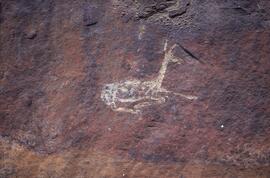
              Rhebuck.

              Rhebuck is one of the antelope that are most frequently depicted, after the eland. The rhebuck is comparable to the eland because it is often painted in shaded polychrome. Both eland and rhebuck are depicted in two colours, mainly red and white, even though they are more grey than red. Depictions of men with rhebuck heads are shamans. It is known that shamans with rhebuck heads controlled eland and harnessed their power to enter trance and to perform their various tasks, including rain-making.
              Blundell, Geoffrey
              RSA LAB1 147
              RARI RARI-RSA-LAB1-147.jpg · Item · 24/12/1995
              Part of RARI
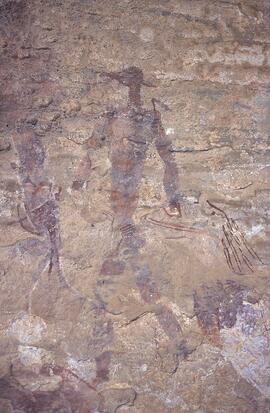
              Therianthropes (antelope), flywhisks, head-dresses, streamers

              Depictions of flywhisks in rock art are quite common. They are important accessories for the trance dance in which they are used to keep arrows of sickness at bay.Paintings of them are a good indication of trance.
              Blundell, Geoffrey
              RSA LAB1 17D
              RARI RARI-RSA-LAB1-17D.jpg · Item · 17/12/2004
              Part of RARI
              Rhebuck.

              Rhebuck is one of the antelope that are most frequently depicted, after the eland. The rhebuck is comparable to the eland because it is often painted in shaded polychrome. Both eland and rhebuck are depicted in two colours, mainly red and white, even though they are more grey than red. Depictions of men with rhebuck heads are shamans. It is known that shamans with rhebuck heads controlled eland and harnessed their power to enter trance and to perform their various tasks, including rain-making.
              Hoerle, Stephane