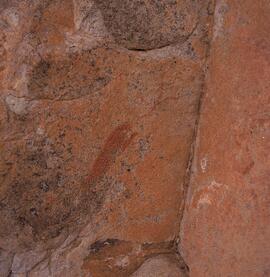
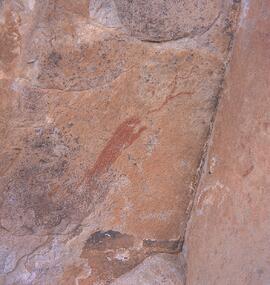
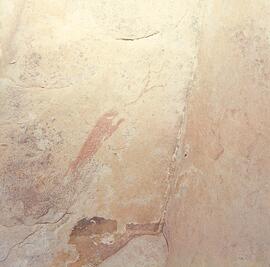
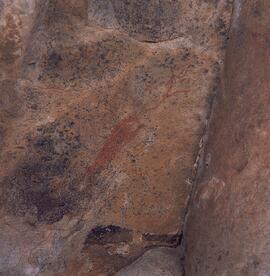
Depictions of felines in rock art are common. Lions in general were believed to have some of the shaman’s accomplishments: they knew things that ordinary people could not possibly know, they could become invisible, and they could cause things to happen by supernatural means. They could also transform themselves into hartebeest and then, when the hunters appeared, revert to their feline form.
Not surprisingly, Bushmen believe shamans can turn themselves into lions. It was also believed that shamans obtained lion-power by eating a lion’s gall, which is believed to be the seat of its potency. When malevolent shamans roam in feline form, the shamans in the camp enter trance and chase them off.
Leopard Cave I
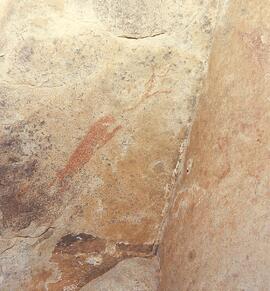
Depictions of felines in rock art are common. Lions in general were believed to have some of the shaman’s accomplishments: they knew things that ordinary people could not possibly know, they could become invisible, and they could cause things to happen by supernatural means. They could also transform themselves into hartebeest and then, when the hunters appeared, revert to their feline form.
Not surprisingly, Bushmen believe shamans can turn themselves into lions. It was also believed that shamans obtained lion-power by eating a lion’s gall, which is believed to be the seat of its potency. When malevolent shamans roam in feline form, the shamans in the camp enter trance and chase them off.
Leopard Cave I
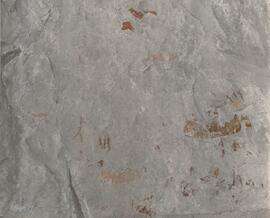
In the open gallery (which form the right part of the shelter), the paintings have very little protection from the sun and rain and nearly all of them are severely damaged. On this panel, an umber of human figures, equipment and remains of animal figures are still recognisable. At the right, a dead eland is lying with its hind legs sticking up. Four bags are painted nearby. P77 pager F258.
RARI
While only a few painted flakes have remained on the upper part of this portion of the wall, a small group of less damaged figures can be seen at the bottom, a few human figures and two beautiful little bucks, all superimposed by a larger eland. Two remains of small bichrome eland can be recognised at the right. P78 pager F260.
RARI