RARI Pager Room

Elements area

Taxonomy

Code

Scope note(s)

    Source note(s)

      Display note(s)

        Hierarchical terms

        RARI Pager Room

          Equivalent terms

          RARI Pager Room

            Associated terms

            RARI Pager Room

              139 Images & Collections results for RARI Pager Room

              139 results directly related Exclude narrower terms
              RARI HPC 01 146HC
              HPC HPC-RARI-HPC-01-146HC.jpg · Item
              Part of Pager, Harald
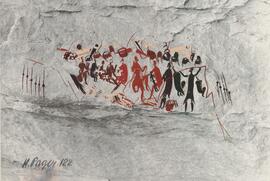
              A tight composition of a gathering of people. Two of the karrosed figures hold up a long line with small dots attached to it. Above the figures lie bags, bows, quivers and unidentified oval objects. The latter have red bands on both ends and a handle in the centre. Below the human figures lie arrows and a container with flywhisks. Left and right of the scene are two sets of digging sticks, three of them with carrying straps attached. This is the last of the paintings at Junction Shelter.
              P122 pager F343.

              Bushman beliefs suggest that bags had a special significance beyond everyday use. Their relation to trance metaphors is illustrated in San mythology, where parallels were drawn between getting into a skin bag and getting into an animal- that is, taking on its potency. Therefore, bags painted next to a dance or by themselves, are probably an indication of a trance experience.

              Quivers are usually made of bark and are used to store arrows. The quiver, bow and other pieces of equipment were carried on a hunting bag, which is wider at one end than the other and which has a thong running its length so that it can be slung over a shoulder.
              RARI
              RARI HPC 01 147HC
              HPC HPC-RARI-HPC-01-147HC.jpg · Item
              Part of Pager, Harald
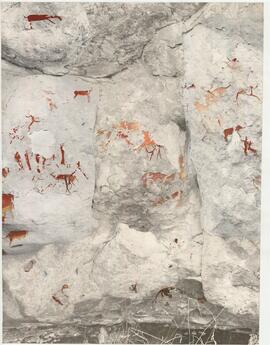
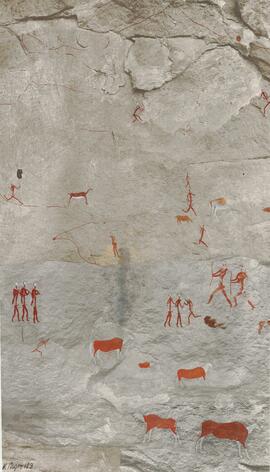
              Game tracks similar to those at the RSA SOR1 meander from the top to the left and then to the centre of the panel. A buck folloowed by a hunter is depicted on one of the lines. Three men with white faces carry killed buck. A few more human figures and buck are loosely spread out on the rock face. One man at the top right wears multiple bead strings around his body. The three eland at the bottom are painted in a bright red.

              The shelter was named by Bert Wood-house and Neil Lee when inadvertently compelled to 'overnight' in it some twenty years ago.
              P123 pager F344.
              RARI
              RARI HPC 01 148HC
              HPC HPC-RARI-HPC-01-148HC.jpg · Item
              Part of Pager, Harald
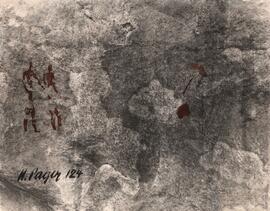
              Two Humans and paint remains situated to their right.
              P124 pager F345.
              Exhaustion Shelter I
              RARI HPC 01 14HC
              HPC HPC-RARI-HPC-01-14HC.jpg · Item
              Part of Pager, Harald
              This section of RSA SEB1 contains a row of women in the top right hand corner. They are super-imposed on two bucks. At the bottom of the panel are some eland in shaded polychrome, one of which has its hooves depicted in a twisted perspective. There is a ladder in the bottom left hand corner of the frieze.

              Towards the bottom of the painting in the centre is a kneeling figure with animal head and horns, which Harald Pager describes as ales or 'flying creatures' of mystical significance.

              Artefacts carried by two figures which Harald Pager describes as heavy clubs may in fact, be pangas, which were often used for hunting and hamstringing elephants.
              P8 pager F90-92-&-94.
              RARI
              RARI HPC 01 15HC
              HPC HPC-RARI-HPC-01-15HC.jpg · Item
              Part of Pager, Harald
              This section of RSA SEB1 contains a row of women in the top right hand corner. They are super-imposed on two bucks. At the bottom of the panel are some eland in shaded polychrome, one of which has its hooves depicted in a twisted perspective. There is a ladder in the bottom left hand corner of the frieze.

              Towards the bottom of the painting in the centre is a kneeling figure with animal head and horns, which Harald Pager describes as ales or 'flying creatures' of mystical significance.

              Artefacts carried by two figures which Harald Pager describes as heavy clubs may in fact, be pangas, which were often used for hunting and hamstringing elephants. Attenuated figures (elongated figures)
              P8 pager F93-95-&-96.
              RARI
              RARI HPC 01 16HC
              HPC HPC-RARI-HPC-01-16HC.jpg · Item
              Part of Pager, Harald
              At the top are some bichrome human figures of which five of them are wearing karosses of various lengths. Bags, quivers and other objects lie nearby. A row of nine tortoise-shaped figures might represent a row seated human figures wearing karosses. The animal on the left looks like an elephant, but it has no trunk. A running man is depicted across its head. There are more running men depicted and a scene of murder, and there is also a downward jumping antelope. Two tall men with bows and arrows are the last in this sequence of superimpositions. Attenuated figures (elongated figures) and elephants.
              P9 pager F97.
              Sibayeni Cave I
              RARI HPC 01 17HC
              HPC HPC-RARI-HPC-01-17HC.jpg · Item
              Part of Pager, Harald
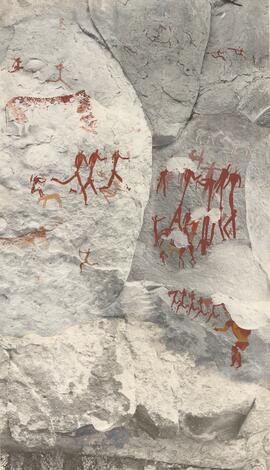
              A shape of obscure meaning and a running human figure at the top with four running human figures lower down.
              P10 pager F102 & F103.
              Sibayeni Cave I
              RARI HPC 01 18HC
              HPC HPC-RARI-HPC-01-18HC.jpg · Item
              Part of Pager, Harald
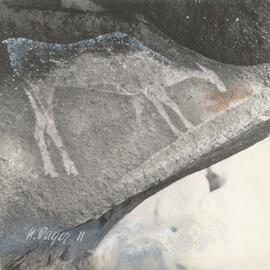
              An eland, painted in shaded white, stands with its front legs in a slanting line. The animal appears to be grazing and a red paint smear below its muzzle might have been placed there to indicate the grass.
              P11 pager F107.
              Sibayeni Cave I
              RARI HPC 01 19HC
              HPC HPC-RARI-HPC-01-19HC.jpg · Item
              Part of Pager, Harald
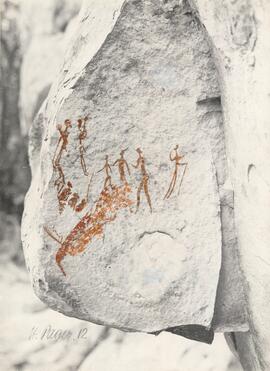
              Exfoliating remains of an animal and human figure in brown. Three of them are seated on the ground and a quiver lies nearby. Quivers.
              P12 pager F108.

              Quivers are usually made of bark and are used to store arrows. The quiver, bow and other pieces of equipment were carried on a hunting bag, which is wider at one end than the other and which has a thong running its length so that it can be slung over a shoulder.
              Sibayeni Cave I
              RARI HPC 01 1HC
              HPC HPC-RARI-HPC-01-1HC.jpg · Item
              Part of Pager, Harald
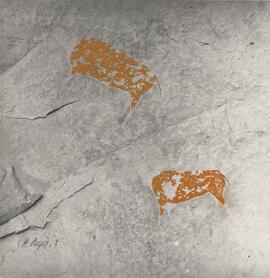
              Two bichrome eland in yellow and white.
              P1 pager F75.
              Sibayeni Cave I
              RARI HPC 01 20HC
              HPC HPC-RARI-HPC-01-20HC.jpg · Item
              Part of Pager, Harald
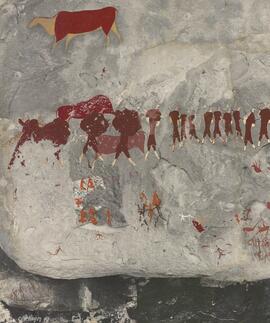
              This is the main frieze at RSA SEB1. The line of marching figures at the top appears to represent a hunting party because at least ten of them are carrying corpses of slaughtered buck over their shoulders.

              The manner of dress is typical of that of a particular group of Bushmen described to the Missionary Ellenberger. On the other hand, all the images have antelope heads and one or two have antelope hooves. Pager classified these figures as mythical and called them antelope men. It may also be considered that these partly human, partly animal figures are representative of the bushman belief that all animals were once people.

              In the centre of the scene, above the large eland, is a figure with a mask-like face and one arm, which terminates in the head of a rhebok. This figure is also something of an enigma but the mask may be representative of an actual mask, facial painting or scarification.

              This frieze is worthy of close study as it includes numerous interesting little scenes painted on a much smaller scale than the main 'procession'.
              Some of these are:
              1. Man following animal tracks (bottom left hand corner).

              2. Two men stick fighting. Each has an elaborate example of the penis additament.

              3. Men using two sticks to mime the movements of an animal (in white).

              4. Ales or 'flying creatures'

              5. Ladder painted in black.(ladders)

              6. Bowman superimposed on the ladder.

              7. Top right hand corner: man with carrying bag apparently milking a spotted animal. This may represent a section of the Milky Way. The Bushmen had many beliefs linked to the stars and other heavenly bodies.

              8.Bottom right hand corner: A herd of rhebok in a variety of attitudes.
              P13 pager F110.
              Sibayeni Cave I
              RARI HPC 01 21HC
              HPC HPC-RARI-HPC-01-21HC.jpg · Item
              Part of Pager, Harald
              This is the main frieze at RSA SEB1. The line of marching figures at the top appears to represent a hunting party because at least ten of them are carrying corpses of slaughtered buck over their shoulders.

              The manner of dress is typical of that of a particular group of Bushmen described to the Missionary Ellenberger. On the other hand, all the images have antelope heads and one or two have antelope hooves. Pager classified these figures as mythical and called them antelope men. It may also be considered that these partly human, partly animal figures are representative of the bushman belief that all animals were once people.

              In the centre of the scene, above the large eland, is a figure with a mask-like face and one arm, which terminates in the head of a rhebok. This figure is also something of an enigma but the mask may be representative of an actual mask, facial painting or scarification.

              This frieze is worthy of close study as it includes numerous interesting little scenes painted on a much smaller scale than the main 'procession'.
              Some of these are:
              1. Man following animal tracks (bottom left hand corner).

              2. Two men stick fighting. Each has an elaborate example of the penis additament.

              3. Men using two sticks to mime the movements of an animal (in white).

              4. Ales or 'flying creatures'

              5. Ladder painted in black. (ladders).

              6. Bowman superimposed on the ladder.

              7. Top right hand corner: man with carrying bag apparently milking a spotted animal. This may represent a section of the Milky Way. The Bushmen had many beliefs linked to the stars and other heavenly bodies.

              8. Bottom right hand corner: A herd of rhebok in a variety of attitudes.
              P13 pager F111.
              Sibayeni Cave I