South African

Elements area

Taxonomy

Code

Scope note(s)

    Source note(s)

      Display note(s)

        Hierarchical terms

        South African

        Equivalent terms

        South African

          Associated terms

          South African

            108 Images & Collections results for South African

            RSA LIN1 7
            RARI RARI-RSA-LIN1-7.jpg · Item · 01/12/1987
            Part of RARI
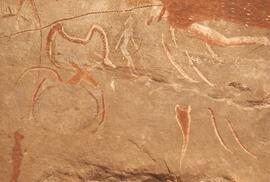
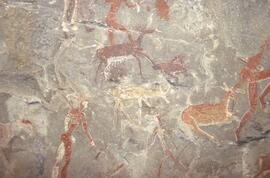
            Rhebuck, human figures, bows, arrows, hunting, antelope.

            Rhebuck is one of the antelope that are most frequently depicted, after the eland. The rhebuck is comparable to the eland because it is often painted in shaded polychrome. Both eland and rhebuck are depicted in two colours, mainly red and white, even though they are more grey than red. Depictions of men with rhebuck heads are shamans. It is known that shamans with rhebuck heads controlled eland and harnessed their power to enter trance and to perform their various tasks, including rain-making.
            Dowson, Thomas
            RSA LIN1 5
            RARI RARI-RSA-LIN1-5.jpg · Item · 01/12/1987
            Part of RARI
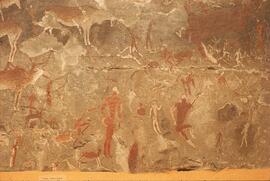
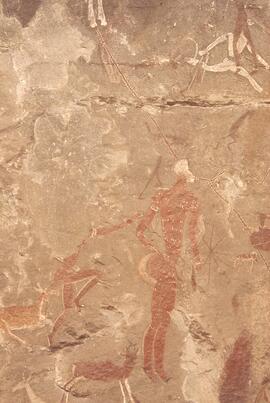
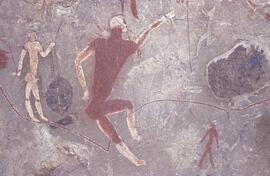
            Human figures, red line with white dots, quivers, sticks, bleeding from the nose, antelope, rhebuck

            Quivers are usually made of bark and are used to store arrows. The quiver, bow and other pieces of equipment were carried on a hunting bag, which is wider at one end than the other and which has a thong running its length so that it can be slung over a shoulder.
            Dowson, Thomas
            RSA LIN1 3R
            RARI RARI-RSA-LIN1-3R.jpg · Item
            Part of RARI
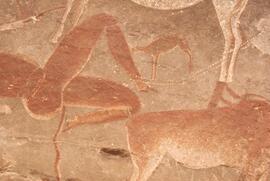
            Therianthropes (eland), birds, tusks, human figures, baboons, arms back posture,sticks, karosses, flecks, bleeding from the nose, dying posture.

            Baboons are painted and engraved more frequently than jackals, and they also feature more frequently in Bushman myth and folklore. The /Xam believed that, like the lion, the baboon had similar powers to those of shamans. It was supposed to draw these powers from a small stick of a plant, which it kept in its left cheek. Some depictions of baboons show a whole troop with males, females and babies. There are also therianthropic baboons which express the closeness of baboons to people and, more important, the association between baboons and shamans.
            Linton I
            RSA LIN1 14
            RARI RARI-RSA-LIN1-14.jpg · Item · 01/12/1987
            Part of RARI
            Therianthropes, rhebuck, bags, animals in bags, red line with white dots, bows, arrows, snakes, fish and eels.

            Depictions of snakes are not uncommon in rock art.Often it is difficult to detect the head because the snake is entering or leaving a crack or step in the rock face. On close inspection, it is noticeable that most are not depictions of real snakes at all.
            Moreover, bushman beliefs about snakes throw light on these puzzling features. It is believed that shamans used burnt snake powder to assist them in the control of their levels of trance. Like snakes, shamans go underground and then surface again when on out-of-body travel, and this probably explains why painted snakes often seem to slither in and out of the rock face.
            Dowson, Thomas
            RSA LIN1 13
            RARI RARI-RSA-LIN1-13.jpg · Item · 01/12/1987
            Part of RARI
            Red line with white dots, rhebuck, therianthropes, snakes Dowson, Thomas
            RARI RSA LIN1 18
            RARI RARI-RARI-RSA-LIN1-18.jpg · Item · 01/12/1987
            Part of RARI
            Removals, human figures, therianthropes, red line with white dots,rhebuck, eland, felines Linton I
            RARI RSA LIN1 17
            RARI RARI-RARI-RSA-LIN1-17.jpg · Item · 01/12/1987
            Part of RARI
            Linton I
            IZI 3186D 7D
            IZI IZI-IZI-3186D-7D.jpg · Item · 18/02/2015
            Part of Iziko Museum
            3186D (3186). Baboons. Linton I