The Cavern II 9708

Elements area

Taxonomy

Code

Scope note(s)

    Source note(s)

      Display note(s)

        Hierarchical terms

        The Cavern II 9708

        The Cavern II 9708

          Equivalent terms

          The Cavern II 9708

            Associated terms

            The Cavern II 9708

              50 Images & Collections results for The Cavern II 9708

              50 results directly related Exclude narrower terms
              NMSA JHH 01 11H
              JHH JHH-NMSA-JHH-01-11H.jpg · Item · 05/1997
              Part of Hone, John
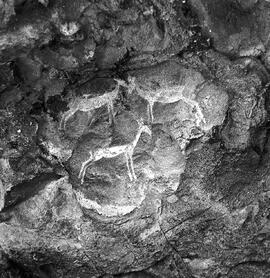
              Rhebuck (reedbuck).
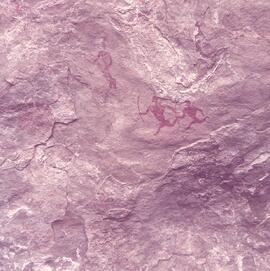
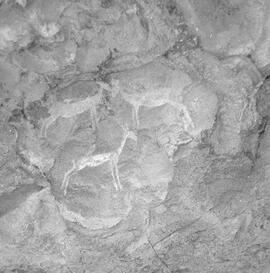
              Rhebuck is one of the antelope that are most frequently depicted, after the eland. The rhebuck is comparable to the eland because it is often painted in shaded polychrome. Both eland and rhebuck are depicted in two colours, mainly red and white, even though they are more grey than red. Depictions of men with rhebuck heads are shamans. It is known that shamans with rhebuck heads controlled eland and harnessed their power to enter trance and to perform their various tasks, including rain-making.
              The Cavern II 9708
              NMSA JHH 01 12H
              JHH JHH-NMSA-JHH-01-12H.jpg · Item · 05/1997
              Part of Hone, John
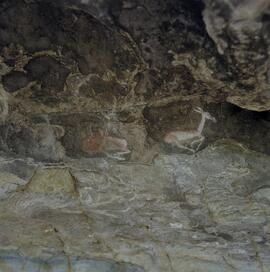
              Birds.
              Birds are commonly depicted in rock art. Some of the depictions of birds are shown swooping down on animals or standing next to dead antelope. In San mythology, flight is a wide spread metaphor for trance experience due to the sensations of rising up and floating that are part of some altered states of consciousness produced by the universal human nervous system.
              The Cavern II 9708
              NMSA JHH 01 362H
              JHH JHH-NMSA-JHH-01-362H.jpg · Item · 01/1996
              Part of Hone, John
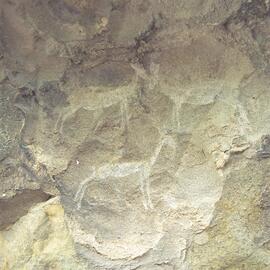
              Rhebuck (reedbuck). The Cavern II 9708
              NMSA JHH 01 365H
              JHH JHH-NMSA-JHH-01-365H.jpg · Item · 01/1996
              Part of Hone, John
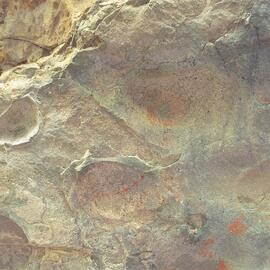
              Bees.
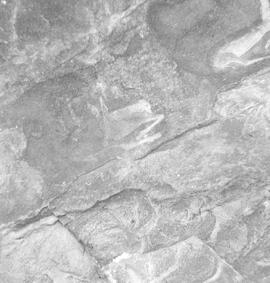
              In rock art, one sees depictions of nested U-shapes with bees. Bushman shamans interpreted this particular shape as a honeycomb because bees are a Bushman symbol of potency. In the Kalahari, Bushmen dance when bees are swarming because they believe that they can harness their potency for a particularly effective dance.
              The Cavern II 9708
              NMSA JHH 01 9H
              JHH JHH-NMSA-JHH-01-9H.jpg · Item · 05/1997
              Part of Hone, John
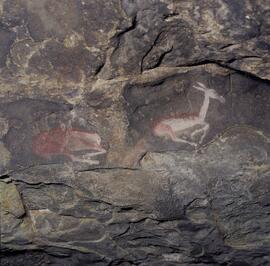
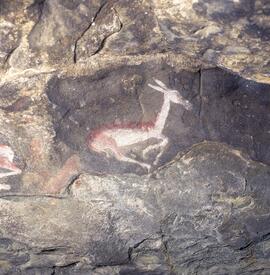
              Rhebuck
              Rhebuck is one of the antelope that are most frequently depicted, after the eland. The rhebuck is comparable to the eland because it is often painted in shaded polychrome. Both eland and rhebuck are depicted in two colours, mainly red and white, even though they are more grey than red. Depictions of men with rhebuck heads are shamans. It is known that shamans with rhebuck heads controlled eland and harnessed their power to enter trance and to perform their various tasks, including rain-making.
              The Cavern II 9708