Identity area
Identifier
Authorized form of name
Parallel form(s) of name
Other form(s) of name
Type
Contact area
Description area
History
Background of the Recorder
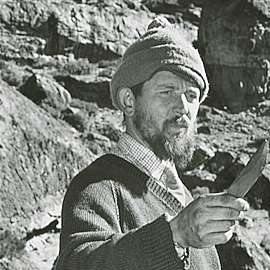
Patrick (Pat) Lea Carter was born on the 24th of June 1931 in the southern English town of Reading. He attended archaeological excavations near Reading while still at school, and later attended the local university where he studied geography and geology. He failed to complete the course, choosing rather to travel and work in Africa and Britain. By October 1955 he was working as a technician at the Uganda Museum, where he later worked with Peter Shinnie on an excavation at Bigo and it was Shinnie who secured for him a post as chief technician in the Department of Archaeology at Legon University, Ghana, in February 1959. During his three years at Legon he worked at numerous Ghanaian sites as well as sites in Mauritania and Sudan. Pat was accompanied to Sudan by Patricia Vinnicombe, whom he first met in 1955 and whom he later married in 1961. After a short return to Ghana, both moved to Cambridge in 1963 where Pat went to St John's College to study Part II of the Archaeology and Anthropology Tripos. Here he worked with Eric Higgs in Greece in 1965 and 1966, and Higgs' emphasis on investigating the relations between people and the landscape they inhabit as well as his excavation techniques strongly influenced Pat. Once Pat completed his BA he returned to East Africa where he worked as Curator of the University Museum at Dar es-Salaam, a post he resigned from after two years due to dissatisfaction with the impact government policy had on the efficient running of the museum. At this point, Pat began to initiate a fieldwork programme in the Maloti-Drakensburg Mountains of Lesotho and KwaZulu-Natal. The fact that Patricia Vinnicombe had grown up here and had been tracing and recording rock art in the region for over a decade, coupled with the fact that Pat had previously worked with the Natal Museum (in the 1950s) made this locality an obvious choice. Also, the potential for a holistic study of rock art, 'dirt' archaeology and landscape change in the Drakensburg was obvious to both Pat and Patricia. After surveying and recording sites in Lesotho and South Africa, six rock-shelters were excavated: Moshebi's Shelter in 1969, Belleview in 1969/70, Good Hope, Ha Soloja and Sehonghong in 1971, and Melikane in 1974. The Lesotho sites, in particular, were very difficult to access and to do fieldwork there would have been a challenge. Pat completed his doctoral thesis in 1978. Among other things, his thesis dealt with his principal interests in Lesotho and southern KwaZulu-Natal - firstly, establishing a cultural-stratigraphic sequence for this area's archaeology, and secondly, that of investigating how people exploited and moved across the landscape. His excavations and surveys, undertaken jointly with Patricia, put Lesotho's archaeology on the map and established the potential for future investigations of Middle Stone Age assemblage variability and hunter-gatherer adaptations and palaeoenvironmental change. Pat returned to Cambridge and was appointed assistant curator at the University Museum of Archaeology and Anthropology in 1973 and became a senior assistant curator in 1989. Here he was involved mainly in the Museum's Stone Age collections, and reorganization of displays. He also played a vital role in teaching Palaeolithic archaeology to students, and was still active in excavating sites in Greece (namely Epirus and Klithi). He was also an active contributor to Downing College life and this was recognized by his election to an Emeritus Fellowship on his retirement in 1991. He suffered from cancer of the kidney and pneumonia in 1997, followed by a mild stroke in 1998 but still made full use of his retirement in which he did great deal of traveling around the world. He died at his home, on the Shropshire/Worcestershire border, on 8th of March 2004