

Identity area
Reference code
Title
Date(s)
Level of description
Extent and medium
Context area
Name of creator
Biographical history
Name of creator
Biographical history
Name of creator
Biographical history
History of the collection
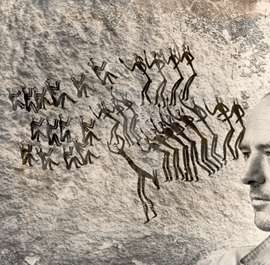
In October 1967, Harald Pager and his wife Shirley-Ann set out for the Drakensberg rock shelters that were to be their home for the next two years. Pager (Austrian by birth) had become interested in San/Bushman rock art in the early 1960's. The sheer beauty of the art captivated him, and he resolved to commit his professional skills as an artist and designer to the recording of these remote images. The Ndedema Gorge, where Pager worked, is in the Cathedral Peak area of the Drakensburg. This great valley contains a remarkable concentration of rock paintings. All in all, Pager recorded a total of 3909 individual images in 17 shelters. Many San paintings are extremely faint and unsuitable for photography. Moreover, the images are often small, measuring only one or two centimeters. When large panels of perhaps a couple of hundred paintings are reduced to a single photograph, these small but imported paintings are virtually invisible. To overcome these and other difficulties, Pager developed a unique recording technique. Using 6x6cm or 6x9cm black and white film, he photographed the rock surface in sections of approximately one square meter. Then life-size black and white prints were made. He took these back to Ndedema Gorge and, working on an easel propped up in front of the paintings, he coloured in the images with oil paints. Some of the faintest paintings had to be outlined in pencil first. In most instances it was necessary to heighten the colour of the originals. Care was taken to record all flakes and damage to the paintings; the rate of deterioration can thus be estimated. The second stage was to assemble the photographs. Wherever possible, Pager cut the photographs along natural cracks and steps in the rock face and then glued pieces together to form a life size mosaic. The presentation of the actual rock is one of the invaluable features of the collection. The Ndedema copies are unique in the history of rock art research and extraordinary valuable research resource. In some shelters up to 12% of the images are no longer visible; they have faded into obscurity. The collection is therefore an irreplaceable treasure: part of our national heritage and international importance. Harald Pager's copies were published in 1971 in a book entitled "Ndedema: A documentation of the rock paintings of the Ndedema Gorge."
Background of the Recorder
Harald Pager was an Austrian who came to South Africa after the Second World War. He was a designer, artist and a photographer of wide experience. During the 1960's Harald Pager became interested in the study of Bushman paintings and in 1967 he decided to devote his full time to a detailed study of the paintings in the area of Ndedema Gorge together with his wife Shirley Ann.
Repository
Archival history
Immediate source of acquisition or transfer
Content and structure area
Scope and content
Of particular note is the eland painted as seen form the back with its head turned to the right and, further on to the right an eland, painted as seen from the front looking straight out of the rock face.
Many of the human figures are so elongated that they give the impression that they might have been modelled on early black hunting parties visiting the area. On the other hand, however, their clothing and artefacts are typical of the Bushmen. A really satisfactory explanation for this elongation has still to be found and it has also been suggested that the Bushmen artists deliberately exaggerated because of their desires not to be considered small. Whatever the explanation, the artistic effect is dramatic and provides an excellent contrast to the shaded polychrome eland.
P40 pager F163 - 164.
Appraisal, destruction and scheduling
Accruals
System of arrangement
Conditions of access and use area
Conditions governing access
Conditions governing reproduction
Language of material
- English
Script of material
Language and script notes
Physical characteristics and technical requirements
Original size: 80.88 x 146.9cm